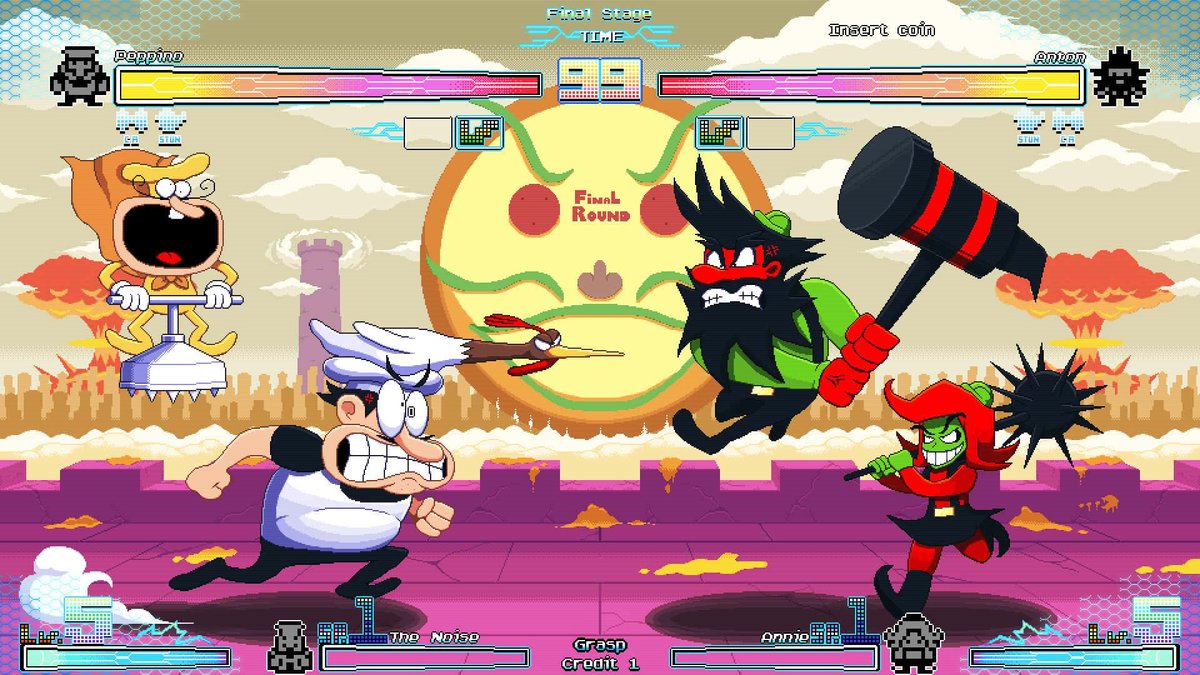
In a world increasingly shaped by algorithms, where artificial intelligence can conjure stunning visuals from mere text prompts, the spotlight often turns to what truly defines art. Is it the flawless execution, the breathtaking realism, or something deeper, more intangible? For a vivid exploration of this question, we need look no further than an unlikely contender: a vibrant, hyperactive indie game known as Pizza Tower. This isn't just a game; it's a masterclass in intentional, expressive pixel artistry. Thus begins our journey into A Visual Showdown: Pizza Tower vs. AI Art.
This isn't just about comparing two different image generators; it’s a crucial dialogue about creativity, craftsmanship, and the very soul of visual expression in the digital age. We're dissecting what makes human-made art resonate and how AI, for all its technical prowess, often struggles to replicate the magic born from the human hand and mind.
At a Glance: What We’ll Explore
- The Unmistakable Charm of Pizza Tower: Unpacking the deliberate design choices, animation principles, and "flaws" that give Pizza Tower its unique, chaotic soul.
- How AI Sees the World (and Art): A brief look at the mechanisms and inherent biases of generative AI art.
- The "Showdown" Itself: Direct comparisons of AI's attempts to mimic Pizza Tower's style, highlighting successes and, more importantly, its significant shortcomings.
- Beyond Mimicry: The potential of AI as a tool for human artists, rather than a replacement for creative intent.
- The Enduring Value of Human Artistry: Why the touch of an artist, with all their imperfections and intent, remains irreplaceable.
The Soul of Speed: Deconstructing Pizza Tower’s Art Style
Before we pit pixels against algorithms, we must first understand the challenger that is Pizza Tower. Released in 2023, this platformer exploded onto the scene not just for its breakneck gameplay, but for its utterly distinctive visual style. It's a game that looks like it was ripped straight from a fever dream of late-90s animation, brimming with personality, kinetic energy, and a deliberate disregard for conventional polish.
What makes Pizza Tower's art so profoundly effective and beloved? It boils down to several key elements:
Intentional Imperfection and Raw Expressiveness
Walk through any level in Pizza Tower, and you'll immediately notice its deliberate "rawness." Characters aren't perfectly symmetrical; lines are chunky and uneven; textures often look hand-painted. This isn't a lack of skill; it's a conscious artistic choice. Inspired heavily by classic Western animation giants like Ren & Stimpy and Earthworm Jim, Pizza Tower embraces:
- Exaggeration: Every character, from the protagonist Peppino Spaghetti to his rogue's gallery of bosses, is a masterclass in exaggerated design. Their expressions contort wildly with emotion – fear, rage, manic joy – making their inner states instantly legible and often hilarious.
- Rough Edges as Personality: The slight irregularities, the visible brushstrokes (even in pixel form), and the chunky outlines contribute to an aesthetic that feels organic and alive. It’s the visual equivalent of punk rock – raw, energetic, and full of attitude. This deliberate lack of "smoothness" gives the game a unique textural quality that hyper-realistic or overly clean graphics often lack.
The Art of Motion: Animation as a Language
Pizza Tower doesn't just look good in stills; it moves with incredible fluidity and character. Its animators employ principles that veteran cartoonists have perfected for decades:
- Smear Frames: Blink and you'll miss them, but these distorted, stretched frames are crucial for conveying speed and impact. When Peppino dashes across the screen, he doesn't just move; he blurs into an abstract shape, communicating incredible velocity. This trick is incredibly difficult to execute manually, requiring a deep understanding of motion and visual storytelling.
- Squash & Stretch: Characters constantly deform to emphasize actions and reactions. Peppino squashes down before a big jump, then stretches out as he propels himself upwards. This isn't just stylistic; it makes the physics of the game feel more impactful and the characters more elastic and alive.
- Anticipation: Before any major action, characters prepare with a preceding motion. Peppino winding up a punch, or a boss recoiling before a charge – these moments build expectation and make every move feel deliberate and weighty.
These animation principles, executed with such verve, are what truly infuse Pizza Tower's visuals with its dynamic, chaotic soul. The art serves the gameplay, enhancing the sense of speed and urgency, making every pixel pop with purpose.
The Algorithm's Brush: A Look at AI Art Generation
On the other side of our visual showdown stands AI art. In just a few short years, generative AI models like Midjourney, DALL-E, and Stable Diffusion have revolutionized how we think about image creation. They can produce astonishingly realistic photographs, replicate famous painting styles, or invent entirely new scenes based on simple text prompts.
How AI "Learns" and Creates
At its core, generative AI art works by analyzing vast datasets of existing images, text descriptions, and artistic styles. It learns patterns, correlations, and common visual elements. When you provide a prompt, the AI essentially predicts what combination of those learned patterns best fits your request, synthesizing a new image from its accumulated knowledge.
AI's Strengths: Speed, Scale, and Realism (Sometimes)
- Instant Gratification: Generate dozens, even hundreds, of variations in seconds. This iterative speed is unparalleled.
- Volume: AI can produce a sheer quantity of images that would take human artists weeks or months.
- Photorealism: For certain types of prompts, especially those aiming for hyperrealistic or traditionally beautiful aesthetics, AI can deliver stunning results that are hard to distinguish from actual photographs.
- Exploration: It's an incredible tool for quickly visualizing concepts, brainstorming ideas, or exploring different stylistic directions.
AI's Limitations: The Nuance Gap
Despite its advancements, AI art frequently stumbles when it comes to the very qualities that define human creativity:
- Lack of True Understanding: AI doesn't understand the concepts it depicts in the way a human does. It doesn't grasp narrative, emotion, or cultural context beyond statistical correlations in its training data.
- Inconsistent Style & Character: Maintaining consistent character designs, facial expressions, or even specific stylistic nuances across multiple generated images remains a significant challenge. Limbs can grow extra digits, perspectives can warp illogically, and details can vanish or appear randomly.
- The "Average" Problem: Because AI learns from averages, its outputs can often feel generic or devoid of a distinct personal voice, especially when pushed outside its comfort zone of aesthetically pleasing norms.
- Struggles with Abstraction and Intentional Distortion: AI finds it difficult to intentionally create "ugly" or "messy" art with purpose. It often tries to "correct" what it perceives as flaws, smoothing out the very imperfections that give a style like Pizza Tower its charm.
The Clash of Canvases: When AI Tries Pizza Tower
This is where the rubber meets the road. What happens when you ask a sophisticated algorithm to replicate the raw, chaotic, and deeply intentional artistry of Pizza Tower? The results, while often fascinating, starkly highlight the chasm between algorithmic mimicry and human ingenuity.
You might have seen examples online, like the "AI Editions" of Pizza Tower bosses or generative fill used to "complete" character portraits (AI-generated Pizza Tower bosses). These attempts are a perfect case study.
Where AI Can "Succeed" (Superficially)
- Color Palettes: AI is generally good at picking up dominant color schemes. It can often replicate the warm, vibrant yellows, reds, and browns that characterize Pizza Tower's world.
- Basic Shapes and Elements: If given very specific prompts, AI can generate images with chunky outlines, pixelated textures, or even character types (e.g., "chef character," "pizza monster").
- Mimicking "Pixel Art": AI can produce images that look like pixel art in the most literal sense – a grid of colored squares. However, the quality of that pixel art is a different story.
Where AI Fundamentally Fails (The Heart of the Matter)
This is where the "showdown" truly crystallizes. AI often misses the crucial elements that define Pizza Tower's style:
- Loss of Expressiveness: AI struggles immensely with the extreme, dynamic expressions that are Pizza Tower's hallmark. When prompted for "Peppino looking scared," AI might give you a generic wide-eyed look, but it won't capture the visceral, body-contorting terror that a human animator imbues into every frame. The wild, almost grotesque facial contortions and body language are simply beyond its current comprehension of emotional nuance.
- The Vanishing Smear Frame: Ask AI to generate a character moving at high speed, and it will typically render a clean, static pose. The smear frame – that beautiful, distorted blur that conveys motion – is an abstract concept rooted in animation principles, not just visual data. AI doesn't understand the purpose behind such a distortion; it sees it as an "error" to be cleaned up.
- Sanitizing the "Mess": AI is often trained on aesthetically pleasing, high-resolution, "clean" images. When confronted with Pizza Tower's deliberate rough edges, chunky lines, and purposeful imperfections, AI tends to "correct" them. It smooths out the lines, regularizes the shapes, and removes the very qualities that give the art its unique grit and character. The raw, energetic feel is replaced by something sterile and generic.
- Inconsistent Character Design: Even within a single image, AI can struggle to maintain consistent details. A character's hat might change shape, their hands might have too many fingers, or their defining features might be subtly altered. For a style as specific as Pizza Tower's, this inconsistency is glaring. The nuances of how AI handles these challenges are fascinating, and you can explore more about them in discussions surrounding how AI interprets unique art styles.
- Misunderstanding Action and Dynamic Poses: Pizza Tower's characters are constantly in motion, performing exaggerated actions. AI can generate figures, but often places them in stiff, unnatural poses, failing to capture the dynamism, anticipation, or follow-through that makes human-drawn animation feel so alive. The raw energy of a character winding up for a charge, or contorting mid-jump, is rarely replicated with convincing fidelity. When people experimented with AI generative fill for VS portraits, as seen on Reddit, the AI could fill in gaps, but the spirit of the original artistry often diminished, yielding results that, while technically complete, lacked the specific "oomph" of the game's original artists.
In essence, AI can mimic the surface-level appearance of Pizza Tower – the colors, the pixel count, perhaps even some thematic elements – but it consistently fails to grasp the intent, the soul, and the purposeful imperfections that make the game's art so profoundly captivating. It's like a machine trying to play jazz: it can hit all the right notes, but it misses the improvisation, the feeling, the 'swing'.
Beyond Replication: AI as a Creative Tool (Not a Replacement)
This isn't to say AI has no place in the world of art or even in contexts that touch upon styles like Pizza Tower's. The crucial distinction lies in how it’s used: as a tool to augment human creativity, rather than an attempt to replace it entirely.
AI for Ideation and Brainstorming
For artists struggling with concept blocks, AI can be a powerful ideation partner. Want to visualize a new enemy type for a platformer? You could prompt AI with "chaotic pizza monster, 90s cartoon style, running, scared expression." While the direct output might not be game-ready, it could spark new ideas, offer unexpected visual combinations, or help an artist quickly iterate on different directions.
Augmenting Artistic Workflows
- Backgrounds and Textures: AI can quickly generate unique or stylized textures and background elements that an artist can then refine, paint over, or integrate into their existing work. This offloads repetitive tasks and frees up time for core creative challenges.
- Style Transfer (with a human touch): While difficult to perfectly replicate Pizza Tower's unique blend, AI can be used to experiment with applying certain stylistic filters or generating images in the general vein of a particular aesthetic, which a human artist can then heavily modify and adapt. The human artist becomes the curator and director.
- Quick Mock-ups: For game developers, AI can rapidly create visual mock-ups for level designs, UI elements, or character concepts, allowing for quicker iteration and feedback cycles before committing to detailed human artistry.
The key here is that the human remains firmly in the driver's seat, using AI as an intelligent brush, a rapid concept generator, or a sophisticated filter, rather than letting it dictate the final artistic vision. This collaboration leverages AI's strengths (speed, vast visual knowledge) while preserving the artist's unique voice, intent, and crucial understanding of nuance and storytelling.
The Unseen Hand: Authorship, Intent, and Art's Future
The "A Visual Showdown: Pizza Tower vs. AI Art" isn't just a technical comparison; it's a philosophical one. It forces us to confront fundamental questions about what constitutes art in the first place.
- What is Authorship? If an AI generates an image, who is the artist? The person who wrote the prompt? The developers who created the AI? The countless artists whose work trained the model? The answer remains complex and hotly debated. Pizza Tower's art, in contrast, has clear authorship: a dedicated team of human artists, animators, and designers.
- The Role of Intent: Human art is imbued with intent. Every chunky line, every smear frame, every exaggerated expression in Pizza Tower serves a deliberate purpose – to convey speed, emotion, or comedic effect. AI, lacking consciousness, lacks intent. It merely executes patterns. This difference profoundly impacts how we emotionally connect with the art.
- The Value of the Imperfect: We often cherish human art precisely because of its imperfections. The visible brushstrokes, the slight stylistic quirks, the evidence of effort – these are hallmarks of human creation. AI art, in its pursuit of statistical perfection, often irons out these "flaws," inadvertently removing much of what makes art feel human and relatable.
- Ethical Considerations: The debate around AI art also encompasses significant ethical concerns, including the use of copyrighted material in training datasets, the potential devaluation of human artistic labor, and the implications for intellectual property. These are not minor footnotes but central challenges that must be addressed as the technology evolves.
The artistic community's relationship with AI is still evolving. While some embrace it as a liberating tool, others view it with deep skepticism, concerned about its impact on the livelihood and recognition of human artists. The conversation around ethical AI in creative fields is more important than ever, influencing policy and shaping the future of digital artistry.
Making Your Own Visual Masterpiece (Human or AI-Assisted)
So, what can we take away from this visual showdown between a pixelated indie gem and a powerful algorithm?
For Aspiring Human Artists: Embrace Your Imperfections
- Study Animation Principles: Dive deep into squash & stretch, smear frames, anticipation, and follow-through. These aren't just techniques; they're the language of motion. Understanding them will elevate any art, pixelated or otherwise.
- Develop a Unique Voice: Don't be afraid to be "messy," "ugly," or unconventional if it serves your artistic vision. Pizza Tower's success lies in its confidence to defy traditional aesthetics for greater expressiveness. Your unique style is your superpower; it's the one thing AI can't truly replicate.
- Focus on Intent: Before drawing a single line, ask yourself why. What emotion are you trying to convey? What story are you telling? This intent will guide your choices and infuse your art with meaning.
- Practice, Practice, Practice: There's no shortcut to developing skill. The human hand and eye require years of training and experience to develop the intuition and mastery seen in Pizza Tower.
For Those Curious About AI Art: Use It Wisely
- Understand Its Limitations: Don't expect AI to replace the human element of deep storytelling or intentional imperfection. Use it for what it's good at: rapid generation, brainstorming, and stylistic exploration.
- Be a Smart Prompt Engineer: Learning to craft precise and nuanced prompts is an art in itself. Experiment with different phrasing, styles, and negative prompts to guide the AI more effectively.
- Always Be the Editor and Director: View AI-generated images as raw material. Your role is to select, refine, edit, and integrate them into a larger, human-conceived vision. AI should serve your creativity, not define it.
- Stay Informed on Ethics: Be aware of the ongoing discussions about copyright, data sourcing, and the responsible use of AI in creative endeavors. Make informed choices about the tools you use.
The Enduring Power of the Human Hand
In the grand visual showdown between Pizza Tower and AI art, the verdict is clear: while AI can mimic, it cannot yet replicate the profound intentionality, the raw expressiveness, and the soul-stirring imperfections that define human artistry. Pizza Tower stands as a vibrant testament to the enduring power of the human hand, the creative mind, and the deliberate choices that imbue art with personality and purpose.
As technology continues its relentless march forward, the conversation isn't about human artists vs. AI. Instead, it's about how we can leverage these powerful tools responsibly and thoughtfully, allowing them to enhance our creative potential without ever losing sight of what truly makes art resonate: the indelible mark of human intent and emotion. The future of art, much like a perfectly crafted pizza, will likely involve a blend of innovative ingredients, but the heart of the recipe will always be the human touch.